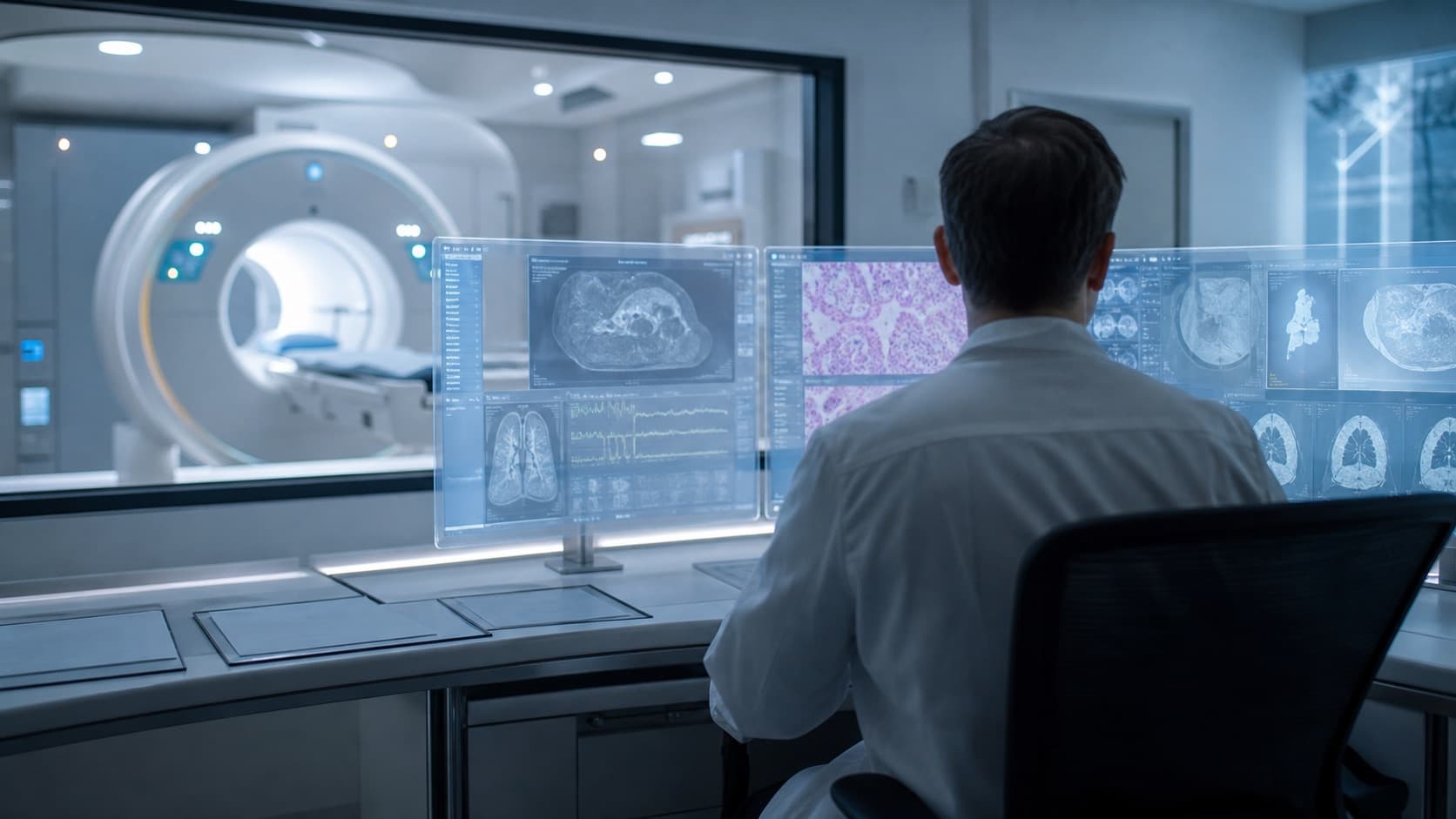
Google Research and DeepMind just published one of the more consequential medical AI papers I’ve read in a while.
Not because they built another chatbot that can answer medical questions.
They built an AI capable of conducting a real-time video medical consultation, watching the patient, listening to them, reasoning about what it sees and hears, guiding parts of a physical examination, maintaining a differential diagnosis, developing a management plan and talking to the patient throughout the process.
And in their controlled study, it performed at or above the level of primary-care physicians across several core clinical competencies.
The system is called AMIE Video, short for Articulate Medical Intelligence Explorer.
What makes this paper particularly interesting to me is the architecture behind it.
Google didn’t ask one giant model to do everything.
They built a multi-agent system.
AMIE Video has three primary agents operating together asynchronously.
The Talker Agent handles the live patient interaction. Its job is speed. It listens to the patient, receives information from the other agents and generates the spoken response with sufficiently low latency to maintain a natural conversation.
Behind it is the Planner Agent.
The Planner isn’t worried about maintaining conversational rhythm. It is performing deeper clinical reasoning in the background, maintaining a running summary of the patient, building the differential diagnosis, developing a management strategy and continuously deciding what the system needs to investigate next.
Then there is the Perception Agent.
It continuously processes the video and audio streams looking for clinically relevant information: visual symptoms, movement, posture, physical findings, vocal characteristics and other audio-visual signals. It maintains a cumulative memory of what it has observed and feeds those observations back into the rest of the system.
That separation matters.
Real-time AI has a fundamental problem: thinking takes time.
Deep reasoning, visual analysis and long-context processing are computationally expensive. Human conversation, however, doesn’t tolerate someone staring silently at you for 30 seconds after every sentence.
Google’s solution is effectively the same architecture we’re beginning to see emerge across sophisticated agent systems:
separate the fast loop from the deep loop.
One agent stays responsive.
Another thinks.
Another perceives.
They continuously exchange state.
Instead of building one omnipotent model, you orchestrate specialized cognitive processes around a shared objective.
And apparently it works.
Google tested AMIE Video in a randomized Objective Structured Clinical Examination involving 100 clinical scenarios, 15 professional patient actors, 10 board-certified primary-care physicians conducting consultations, and 20 additional physicians evaluating them.
The diagnostic numbers immediately jump out.
AMIE Video placed the correct diagnosis first 91% of the time.
The physicians: 77%.
Its top-three diagnostic accuracy reached 98%, compared with 90% for physicians, although that latter difference was not statistically significant after adjustment.
But diagnosis was only part of the evaluation.
Independent clinical evaluators scored the consultations across history-taking, perception and examination, clinical reasoning, treatment planning and communication.
AMIE was rated equivalent to or better than the physicians across all six case-specific clinical domains examined in the study.
Then something even more interesting happened.
The patients began preferring parts of the AI interaction.
The professional patient actors significantly favored AMIE when it came to assessing their condition and explaining their condition. Physicians retained an advantage in the more deeply human dimensions of the interaction, particularly rapport and partnership building, although those differences were not statistically significant in that comparison.
Google also compared video AMIE against text AMIE.
Video won decisively on the interaction itself.
Patients rated video higher for effectively communicating their health concerns, 89% versus 79%.
Ease and convenience: 88% versus 71%.
Feeling fully understood: 90% versus 81%.
That tells us something important about where multimodal AI is going.
For years we’ve been shoving human reality through a text box.
But medicine isn’t a text problem.
Neither is most of life.
A physician doesn’t only process the words you say. They notice your breathing. Your posture. The way you’re holding your arm. Your facial expression. Your voice. Your movement. Whether you look confused. Whether you’re struggling to perform an examination correctly.
Once AI begins operating directly across vision + audio + language + memory + reasoning + action, the interaction fundamentally changes.
The interface starts disappearing.
You stop translating reality into prompts.
You simply show the machine reality.
There are important reasons not to overstate the result.
This was not a hospital deployment. It wasn’t a study of an autonomous AI treating ordinary patients in the wild.
The encounters were standardized simulations performed by professional patient actors, and the scenarios were necessarily limited to conditions that actors could convincingly portray over video. Google explicitly states that AMIE Video is not ready for real-world clinical deployment.
Its perception isn’t perfect either.
Fine anatomical details remain difficult. Subtle emotional cues can be missed. High-frequency movements such as tremors are challenging. The system still uses discrete conversational turn-taking rather than the fluid, overlapping speech humans naturally use, and correctly perceiving something doesn’t always mean the system takes the correct clinical action.
Those are serious limitations in medicine.
But don’t miss what has already happened because the unfinished parts are easier to see.
We spent the first era of generative AI asking whether an LLM could answer medical questions.
We’re moving into a completely different era.
The question is becoming whether an agentic multimodal system can participate in the clinical encounter itself.
Watching.
Listening.
Remembering.
Reasoning.
Planning.
Conversing.
And coordinating specialized AI processes continuously behind the scenes.
That architecture extends far beyond healthcare.
An AI tutor can watch a student solve a problem while another agent models what they misunderstand.
An AI technician can observe machinery while another agent searches diagnostic possibilities and another guides the worker.
An AI engineer can inspect a physical system while specialized agents reason over schematics, sensor data and maintenance history.
An AI assistant can participate in the physical world instead of waiting for someone to describe it.
That’s why I think the deeper story of AMIE Video isn’t simply:
“AI can diagnose patients.”
It’s that we’re beginning to see the architecture of systems capable of maintaining real-time situational intelligence.
Perception happens continuously.
Reasoning happens asynchronously.
Specialists operate in parallel.
And a conversational agent becomes the human-facing surface of an entire machine intelligence operating behind it.
We keep calling these things chatbots because that’s the interface we started with.
That description is becoming obsolete.
AMIE Video looks much more like the early architecture of an AI professional.
And healthcare may only be the first place where we get to watch that transition happen.
This essay was written by Blocpod and originally published on Medium. It is preserved here with its original publication date and a custom LaunchPad Observer cover. Read the canonical edition