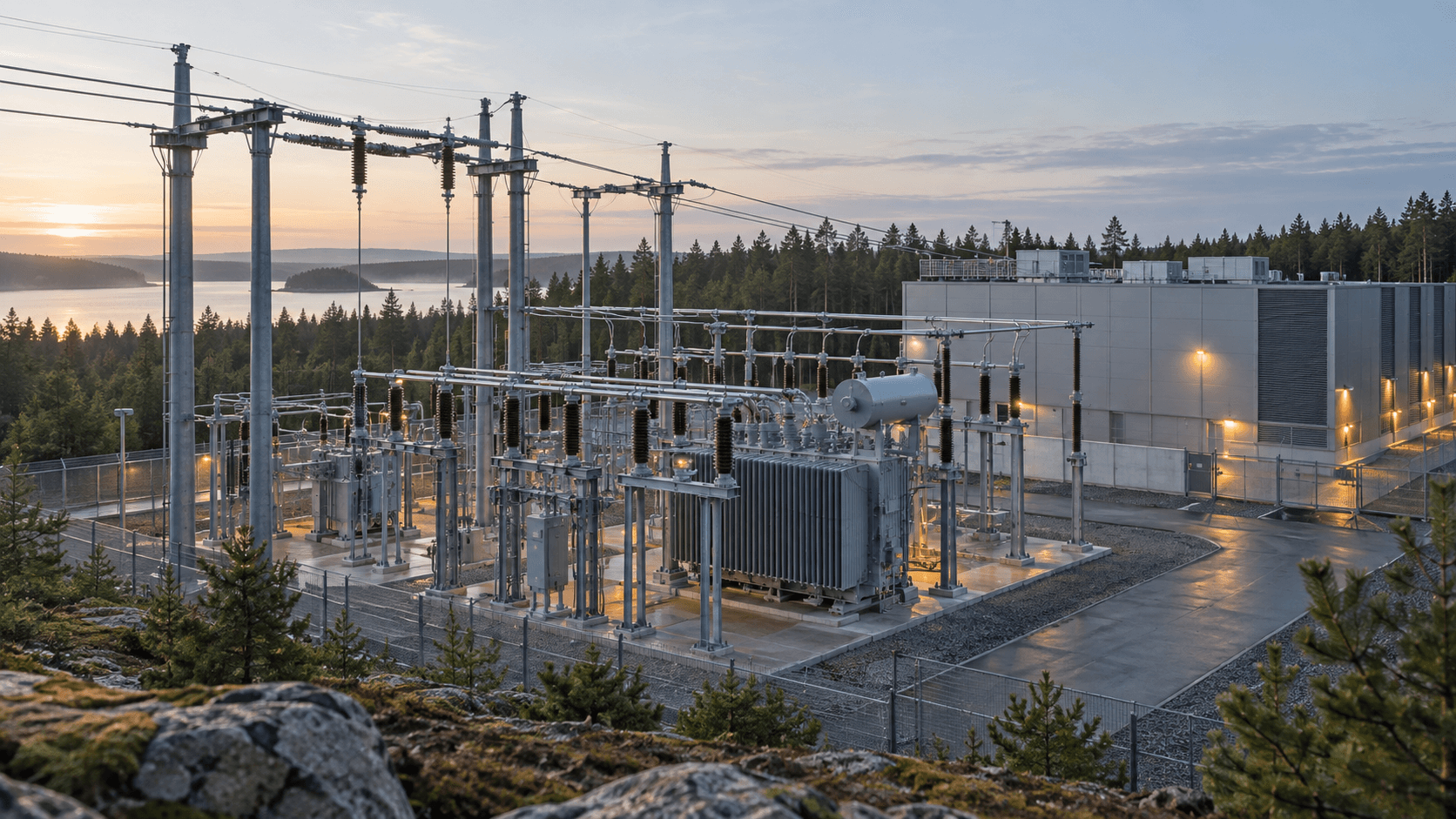
Finland has become a test of whether the AI industry can expand without making everyone around it pay for the electricity problem. Google's new investment package combines computing facilities, a long nuclear power contract, wind projects, and a battery. The interesting part is how those pieces fit together. The uncomfortable part is that the studies supporting the plan also explain why a large investment announcement cannot guarantee an affordable electricity bill.
On September 9, Google announced a 13 billion euro investment in Finnish digital infrastructure, energy projects, and partnerships over 2027 and 2028. The program spans Hamina, Kajaani, Muhos, and Vaala. That is a consequential commitment to physical infrastructure behind services including Search, Maps, and Gemini. It is not an announcement of a completed computing fleet, and the public information does not support inventing a GPU count or a precise new training capacity.
Independent reporting by The Register found a particularly important disclosure gap: Google declined to specify the number of facilities it was building or the additional infrastructure capacity. This limits what anyone can calculate from the headline budget. Dividing that budget by an assumed chip price would not reveal the fleet. Construction, energy, and supporting infrastructure are part of the package. The correct response to an undisclosed denominator is to leave it undisclosed.
One contract is much more specific. Fortum says its signed power purchase agreement with Google begins with a smaller allocation in 2028 and reaches half of Loviisa nuclear plant capacity during 2030 through 2049. The agreement runs for 22 years. This is a purchase arrangement for power, not Google's acquisition of half a nuclear plant. Fortum remains the owner, and the operating investment remains a separate undertaking.
Fortum links the contract to its roughly 1 billion euro lifetime-extension program, intended to sustain operations through 2050. It says around 700 million euros of expenditure and 80 percent of the projects still await investment decisions. That distinction matters: a buyer can make a project more financeable before the owner has approved and executed every part of it. Fortum also expects a further 10-megawatt capacity increase beyond an already planned 38-megawatt upgrade. These are expected additions, not electricity already delivered.
The commercial logic is understandable. A long-term customer gives the operator a clearer revenue horizon against which to assess investment. For the customer, the arrangement supports a supply source with a much longer operating horizon than an annual procurement exercise. But neither the announcement nor the public contract summary gives readers a power price from which to calculate Google's savings. Declaring the deal cheap, or an automatic windfall for either party, would run ahead of the disclosures.
The geography is just as important as the contract. Fingrid, Finland's transmission system operator, says more than 70 percent of the country's generation sits in the west and north, while more than half of consumption is in the south. Its account describes local congestion in the southern grid and stronger opportunities for large connections elsewhere. A country can have abundant generation and still have trouble delivering new demand at a particular location.
For a builder, the implication is to make the grid comparison before committing to land. Ask what changes if the same facility goes near generation instead of near existing demand. That is a better starting point than treating every parcel with a power line as an equivalent industrial site.
Google commissioned Baringa to quantify that location choice in a hypothetical case. The consultancy estimated that placing one gigawatt of new baseload demand in the Oulu-Kajaani corridor rather than near Helsinki could reduce network costs by about 520 million euros over 20 years. The modeled savings come from congestion, transmission losses, and reinforcement. One gigawatt is the study's illustrative load, not a newly disclosed specification for Google's Finnish development.
That comparison is useful precisely because it is narrower than the publicity around it. It asks what changes when the same demand goes in a different place. It does not prove that adding the demand has no cost, or that every household receives a particular rebate. For project planners, the constructive lesson is to request the same comparison before locking down a site. Show the connection burden and the alternative location, not just the local tax incentive.
A separate Google-commissioned analysis by AFRY examines wholesale prices and volatility rather than network costs. Using its own assumptions and BID3 model across 2026 through 2035, AFRY estimates that roughly five to seven gigawatts of generation and flexibility capacity could be needed per gigawatt of new baseload demand to offset both effects. That is a modeled portfolio requirement, not a universal rule that every data center must buy seven times its rated load.
AFRY's most important qualification is about the benchmark. Mitigation means returning to an underlying price trend that its model already expects to rise, not freezing prices at today's level. It also says the business case for the large flexibility buildout behind its most stable results remains uncertain. A technically achievable scenario is not a financed construction schedule. Those caveats belong next to the favorable conclusion, not buried underneath it.
The two studies should therefore not be combined into a single promise that the project will lower everyone's bill. Baringa compares locations and network costs. AFRY examines a supply-and-demand response in a wider electricity market. My conclusion from that difference is practical: ask for separate evidence on connection costs, market prices, and delivery timing. Success in one category does not automatically settle the others. A favorable site can coexist with an incomplete energy portfolio.
Google's announced portfolio includes new onshore wind agreements that bring its contracted new-to-the-grid Finnish wind capacity to 629 megawatts. It also describes a 94-megawatt battery near Kajaani, expected to operate in late 2027. The battery figure is a power rating. Without a disclosed energy capacity or discharge duration in these announcements, it cannot tell us how long the system could cover a particular shortfall. A large-looking number should not be used to imply an undisclosed endurance.
Google also says it will explore demand response with grid operators, building on a Hamina pilot. That means investigating when data-center demand could be reduced during grid stress; it is not a promise that every future workload can be interrupted. The useful follow-up is operational: which demand can move, under what conditions, and with what service consequences? A flexibility claim becomes valuable when the operator can explain the action it will take, rather than simply putting another technology on the portfolio slide.
There is a second location tradeoff that deserves attention. Google's May 2024 description of its Hamina heat-recovery project set out plans to supply nearby district heating through city-owned Haminan Energia. It cited an estimate of 80 percent of that local network's annual heat demand. That was a dated project forecast, not a claim about Finland's national heating needs or a measurement of this new expansion. It demonstrates a design approach, not a universal result.
Heat reuse creates a different relationship with the surrounding community from power procurement. Useful heat has to reach a suitable customer, and the earlier Hamina plan identified a specific local network. It should not be generalized into free electricity for nearby households. A sensible evaluation would ask whether a proposed campus has an actual heat recipient and delivery arrangement, alongside its electricity connection. Environmental value needs a destination and a use, not merely a recoverable byproduct.
Fingrid explicitly recognizes the tension: cities offer opportunities to use waste heat, yet southern urban locations are not always attractive from the transmission perspective. This is a genuine design constraint. The best heat customer and the easiest power connection need not occupy the same place. For builders, the implication is to assess the complete site rather than optimize one impressive metric. A heat-recovery rendering cannot compensate for a connection plan that does not work.
The political response is already testing the industry's assurances. Reuters reported on September 10 that Centre Party leader Antti Kaikkonen called for a national permitting system for data-center investment, citing the need to consider electricity and transmission together. Social Democrats also raised affordability and supply concerns. Prime Minister Petteri Orpo, by contrast, said the Google deal would support growth and keep prices under control. Those are competing assessments, not evidence of a new law or an actual power shortage.
The concern should not be dismissed as hostility to technology. Nor does it establish that this particular expansion will damage Finland's grid. The defensible question is who checks cumulative demand against the delivery of the supporting infrastructure. A single developer's well-chosen site is part of that answer, but it is not a national coordination system. Conversely, a new permitting requirement would need to explain what it measures and improves, rather than merely adding another queue.
Google also projects that construction will support more than 37,000 jobs nationwide and contribute 3.6 billion euros annually to GDP during the initial build phase. Those are economic-impact forecasts. They are not a promise of 37,000 permanent Google positions. A community evaluating the project should separate temporary construction activity, ongoing operations, supplier business, and other benefits before deciding what the headline means locally. Each is valuable in a different way and should be judged against its own evidence.
The next useful disclosures would make the plan auditable: actual computing capacity, connection milestones, power-project commissioning, battery duration, and the terms under which demand can be reduced. The nuclear extension also needs its remaining investment decisions and execution, not just a customer signature. My assessment is that Finland is receiving a more serious proposition than an isolated data-center announcement. The standard now is whether its infrastructure arrives in step with demand. That is where an AI investment becomes a durable industrial contribution.
LaunchPad positionJudge large AI developments by delivered power, connection capacity, flexibility, and local economics, not by adding every announced megawatt together.
This report draws on the linked primary sources and reputable reporting. Company statements are treated as claims until independently demonstrated.