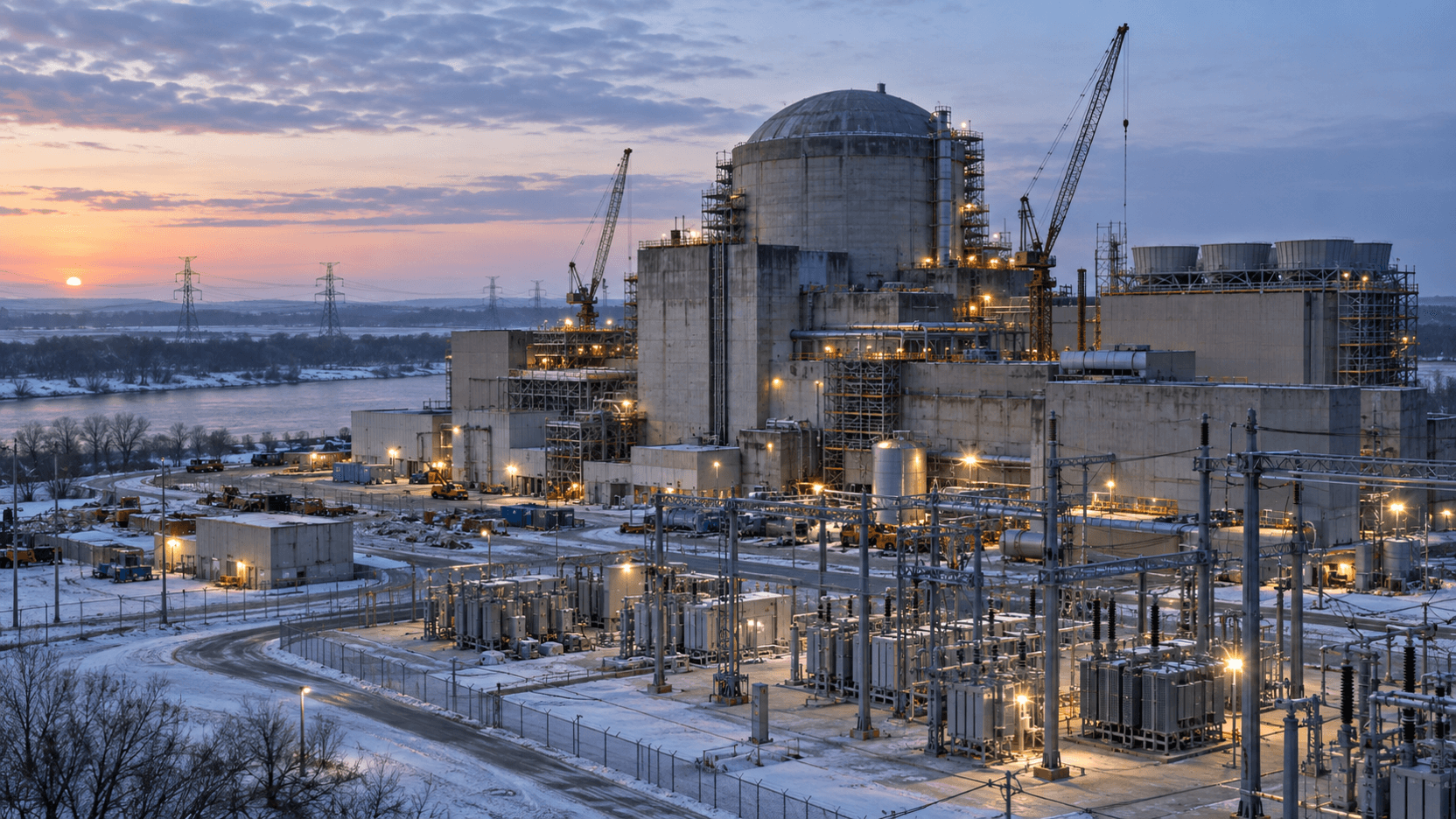
A hyperscaler has found a way to make a retired nuclear plant financeable. That is the real news from Iowa. On September 8, the Department of Energy said it had financially closed a loan of up to $1.9 billion for NextEra Energy's proposed restart of the Duane Arnold Energy Center. Google has already signed a 25-year agreement for power associated with the project. The reactor is still shut down. The Nuclear Regulatory Commission has not approved the restart. Every sentence in this story has to hold those facts at the same time.
The easy version of the headline says AI brought a nuclear plant back from the dead. That is premature. Financial close means the federal financing structure has moved from a conditional commitment into an executed loan arrangement. It does not mean the entire $1.9 billion has been disbursed, the restoration work is finished, or electricity is flowing. DOE describes the loan as being for up to that amount, and both the department and NextEra say the project remains subject to regulatory approvals.
What changed is the project's ability to move. A restart requires years of engineering, procurement, inspections, workforce rebuilding, equipment qualification, fuel planning, and regulatory work before a plant can sell a single megawatt-hour. Those activities consume capital long before revenue arrives. A long-term buyer can make the future cash flow legible. A federal loan can lower the financing barrier. Together, they turn a speculative restart concept into a program that can fund the work required to prove itself.
Duane Arnold is a 615-megawatt boiling-water reactor near Palo, Iowa. It permanently shut down in August 2020 after a derecho damaged non-safety-related portions of the site, including cooling towers. The operator certified that fuel had been removed from the reactor in October of that year. Restarting from that condition is not the same as delaying a routine outage. The plant has spent years in a shutdown posture, and the operating organization, equipment, procedures, and licensing basis all have to be rebuilt for service.
The NRC's public restart page makes the sequence plain. Inspectors are conducting work intended to establish an objective, documented basis for a return to an operating program. The commission approved a transfer of ownership in March 2026, but it explicitly treats that action as separate from the other licensing decisions needed for restart. Ownership is paperwork about who controls the asset. Restart authorization is a safety judgment about whether the plant is ready to operate.
NextEra is targeting the first quarter of 2029. That date should be treated as a company target, not an appointment the grid can put on its calendar. The company still has to complete restoration, satisfy the NRC, rebuild operating capability, and navigate the ordinary failure modes of a large industrial project. A three-year schedule can look generous in a slide deck and vicious when a custom component, inspection result, or regulatory question lands in the critical path.
Google's role is commercially decisive but often described badly. In October 2025, NextEra and Google announced a 25-year power purchase agreement connected to the restart. Google said it planned to use the electricity for its cloud and AI infrastructure in Iowa. The Central Iowa Power Cooperative is expected to purchase the plant's remaining output under the same terms. NextEra also said it had agreements to acquire the minority interests it did not already own.
That does not mean a private wire runs from the reactor to a Google data center. Power purchase agreements are financial and contractual structures that support generation and match demand within the grid system. Electrons move through a shared network governed by physics and grid operations. The agreement gives the project a committed buyer and gives Google a long-duration claim on associated energy and capacity. It does not create a physically isolated reactor reserved for one company.
This distinction matters because the entire AI power conversation is full of magical thinking. A company announces a gigawatt target and suddenly the market behaves as if new capacity has materialized. It has not. Electricity is the final output of a chain involving land, interconnection, equipment, permits, fuel, construction, operators, and transmission. Google has helped finance the demand side of that chain. DOE has strengthened the capital side. NextEra and the regulators still have to deliver the plant.
The financing structure is a template worth watching. Data-center developers need large blocks of reliable electricity on timelines that increasingly collide with grid constraints. Existing nuclear sites already possess valuable assets, including grid connections, transmission access, cooling infrastructure, licensed boundaries, and local operating history. Restarting a retired plant can be more plausible than building a new reactor from an empty field, but it is not automatically faster, cheaper, or safe. Each site carries its own hardware condition, workforce history, regulatory record, and restoration burden.
A committed technology buyer changes the risk calculation. Twenty-five years is long enough to support expensive work that would look irrational against volatile short-term power prices. It also forces the buyer to behave like an infrastructure participant instead of a software customer. Google is not shopping for another cloud subscription. It is making a multidecade commitment that can support a generation asset through restoration and operation. That is what serious demand looks like when the product takes years to build.
The federal government is not merely applauding from the ribbon-cutting line. By closing the loan, DOE is accepting a financing role in a project tied to private demand. The department says the plant could support nearly 1,500 construction jobs and more than 450 permanent operating jobs. NextEra publishes additional projections for state economic activity and consumer benefits. These are forecasts from the project sponsors, not completed outcomes. They become real only if the restart happens and the plant operates reliably.
The government has supported other reactor restart efforts, including Palisades in Michigan and the Crane Clean Energy Center project at the former Three Mile Island site. That emerging pattern matters. Nuclear restarts are moving from one-off curiosities into a policy tool for recovering firm capacity from existing assets. AI demand is not the only reason. Grid reliability, manufacturing growth, electrification, and the retirement of older generators all add pressure. AI is the buyer with enough urgency and balance-sheet weight to accelerate the dealmaking.
There is a legitimate public-policy question inside the structure. Federal credit is scarce and taxpayers absorb risk if a borrower fails. The case for using it here is that a large, zero-emission generating asset could return to the grid, support regional employment, and avoid the time and cost of building entirely new infrastructure. The counterargument is that a powerful technology company and a major utility should finance their own demand. The answer depends on loan terms, risk allocation, public benefits, and whether the project actually performs.
The public record released with the announcement does not settle every economic question. It establishes the maximum loan amount and the project's basic purpose, but it does not give outside readers a complete operating model for every restoration cost, contingency, or future power price. That uncertainty should not be filled with confident guesses. The right evaluation is procedural: watch disbursements, regulatory milestones, construction progress, schedule changes, and the conditions attached to the federal financing.
There is also no honest way to promise lower customer bills from the announcement alone. NextEra says the structure will protect or benefit customers, and the Iowa Utilities Commission granted a certificate in June. But customer outcomes depend on contract terms, allocation of costs, grid conditions, and the performance of the plant over decades. A cheap loan can improve project economics. It cannot repeal maintenance, outage, fuel, and transmission costs.
The operational challenge begins with people. A nuclear plant is not a collection of equipment that can be powered on after a long weekend. It requires licensed operators, engineers, maintenance crews, security staff, emergency planning, quality assurance, training systems, and a culture that survives turnover. NextEra projects more than 400 permanent jobs. Filling those roles with qualified people while restoring the plant is part of the critical path, not an economic-development bonus stapled to the end.
Equipment condition will be equally unforgiving. Systems maintained for shutdown are not automatically qualified for full-power operation. Components age even when a reactor does not run. Documentation has to match physical reality. Temporary fixes cannot quietly become operating assumptions. The NRC's insistence on an objective basis for restart is what separates an infrastructure program from a revival narrative. The plant has to demonstrate readiness system by system, test by test, and procedure by procedure.
For Google, the project is a hedge against a strategic constraint. AI models may improve quickly, but data centers remain industrial facilities with power, cooling, networking, and construction limits. A company can optimize chips and software while still waiting years for a substation or generation project. Long-term nuclear procurement gives Google a route to firm power that is not dependent on weather. It also exposes the company to schedules and institutions that move nothing like software.
That collision may be healthy. Technology companies are accustomed to scaling products by copying software and buying standardized hardware. Energy forces them to deal with place, time, regulation, and physical failure. The Duane Arnold deal says the next phase of AI competition will not be decided only by who trains the strongest model. It will also be decided by who can assemble credible coalitions around generation, grids, financing, and communities without pretending any one contract solves the whole system.
For Iowa and the wider grid, the most valuable outcome would be a plant that operates safely and predictably for years. A successful restart could add a large block of firm capacity without waiting for a greenfield nuclear project. A failed or badly delayed restart would tie up capital, damage confidence, and remind everyone that an existing interconnection does not erase industrial complexity. The site offers leverage because infrastructure already exists. It also carries history that cannot be wished away.
The scorecard is straightforward. First, watch whether the NRC accepts the licensing path and whether inspections identify major work. Second, watch restoration milestones, staffing, and fuel preparation. Third, watch the financing draw against actual progress. Fourth, watch whether the first-quarter 2029 target moves. Finally, if the reactor returns, watch availability, outage performance, and the difference between forecast economics and operating results. Everything before sustained generation is preparation.
The strongest conclusion today is not that AI has revived nuclear power. It is that AI demand has become credible enough to reorganize nuclear finance. Google has supplied a long-term customer. DOE has supplied federal credit. NextEra has supplied the asset and execution responsibility. The NRC retains the authority to say whether the machine is ready. That is a serious stack of institutions, not software confetti. Now they have to turn a contract, a loan, and a retired reactor into 615 megawatts that actually show up.
LaunchPad positionAI power procurement is turning into infrastructure finance. Google supplies long-term demand, the federal government supplies debt capacity, NextEra supplies the asset and operating plan, and the NRC decides whether the reactor can safely return. The structure is real. The electricity and the 2029 schedule still have to survive construction, licensing, staffing, and grid reality.
This report draws on the linked primary sources and reputable reporting. Company statements are treated as claims until independently demonstrated.