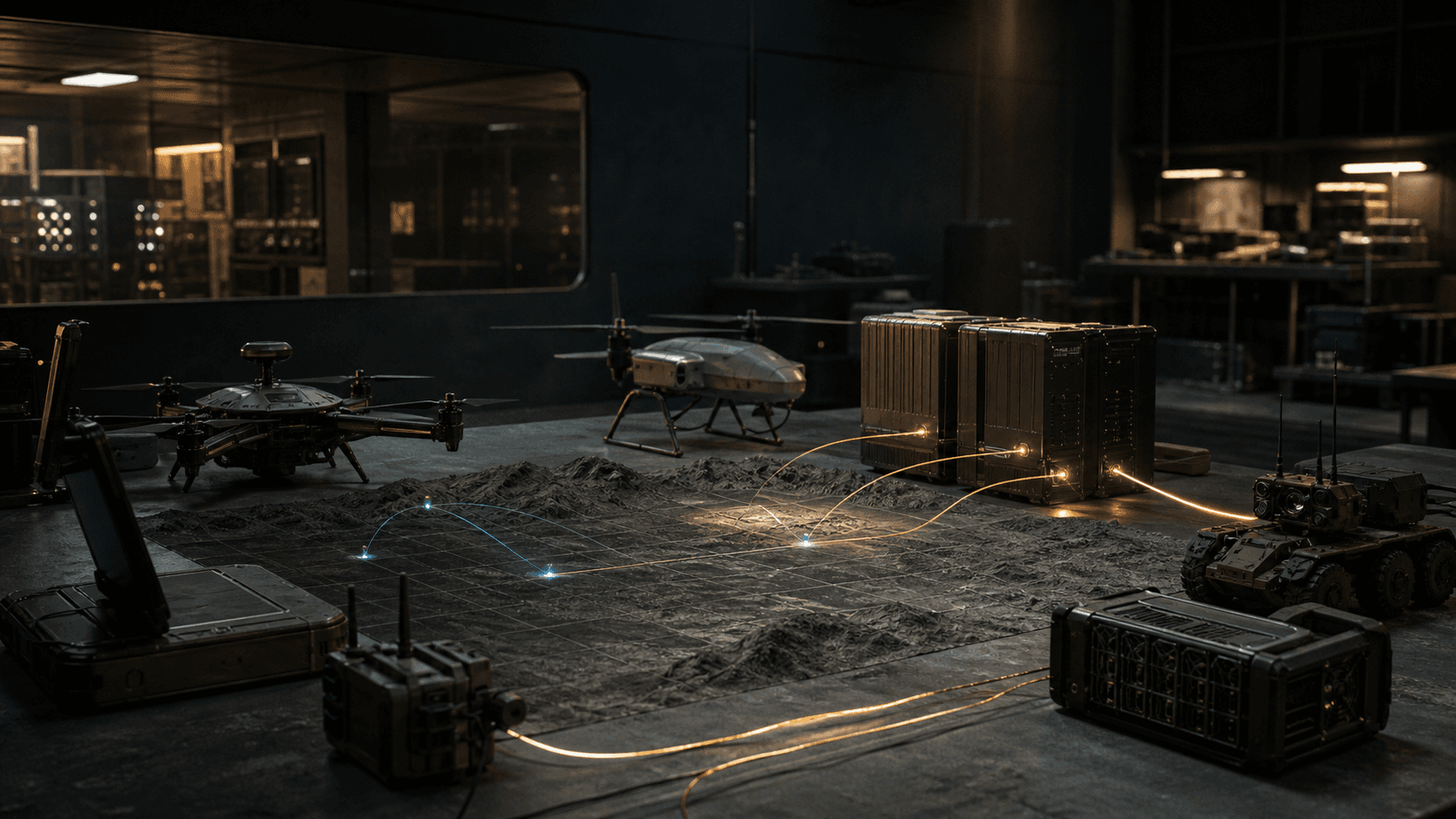
Governments love announcing taskforces because a taskforce looks like motion before anyone has to ship anything.
The United Kingdom's Ministry of Defence has now given its Rapid AI Delivery Taskforce, called RAID, a more concrete operating shape. Guidance published August 25 identifies four focus areas: understanding and decision advantage, electromagnetic and information advantage, planning and automation, and autonomous systems. The government says 100 million pounds will support the effort through its Defence Investment Plan.
The new piece is an Industry Front Door, a channel for companies and researchers to present relevant technology to the taskforce. RAID says it will use the channel for horizon scanning, targeted engagement, and collaboration around priority problems. The same guidance is explicit about what the front door is not: it is not a request for proposals, not a procurement commitment, and not a promise of funding.
That disclaimer is honest and important. Defense innovation programs often become excellent machines for collecting pitches and weak machines for converting capability into operational use. The hard work begins after discovery: security classification, access to representative data, evaluation against real constraints, integration with legacy systems, contracting, safety approval, training, and feedback from the people expected to trust the tool under pressure.
RAID reports to the Chief of the Defence Staff, which at least puts the program close to operational leadership. Its focus areas also avoid the lazy framing that military AI is only autonomous weapons. Decision support, electromagnetic operations, planning, logistics, and human-machine teaming can change tempo long before a machine acts independently.
But speed needs a measurable definition. A credible delivery program should publish how many proposals enter the channel, how quickly they are triaged, how many reach funded trials, how many survive operational evaluation, and how many become maintained capabilities. Without that funnel, 100 million pounds can disappear into demonstrations that photograph beautifully and die in integration.
The front door solves one coordination problem: outsiders now know where to knock. The next move is building the hallway from a useful prototype to a deployed system. That is where defense AI strategies either become capability or become another PDF with a budget.
LaunchPad positionThe taskforce will matter only if ideas can move through security review, contracting, integration, field testing, and operator feedback faster than the technology changes.
This report draws on the linked primary sources and reputable reporting. Company statements are treated as claims until independently demonstrated.