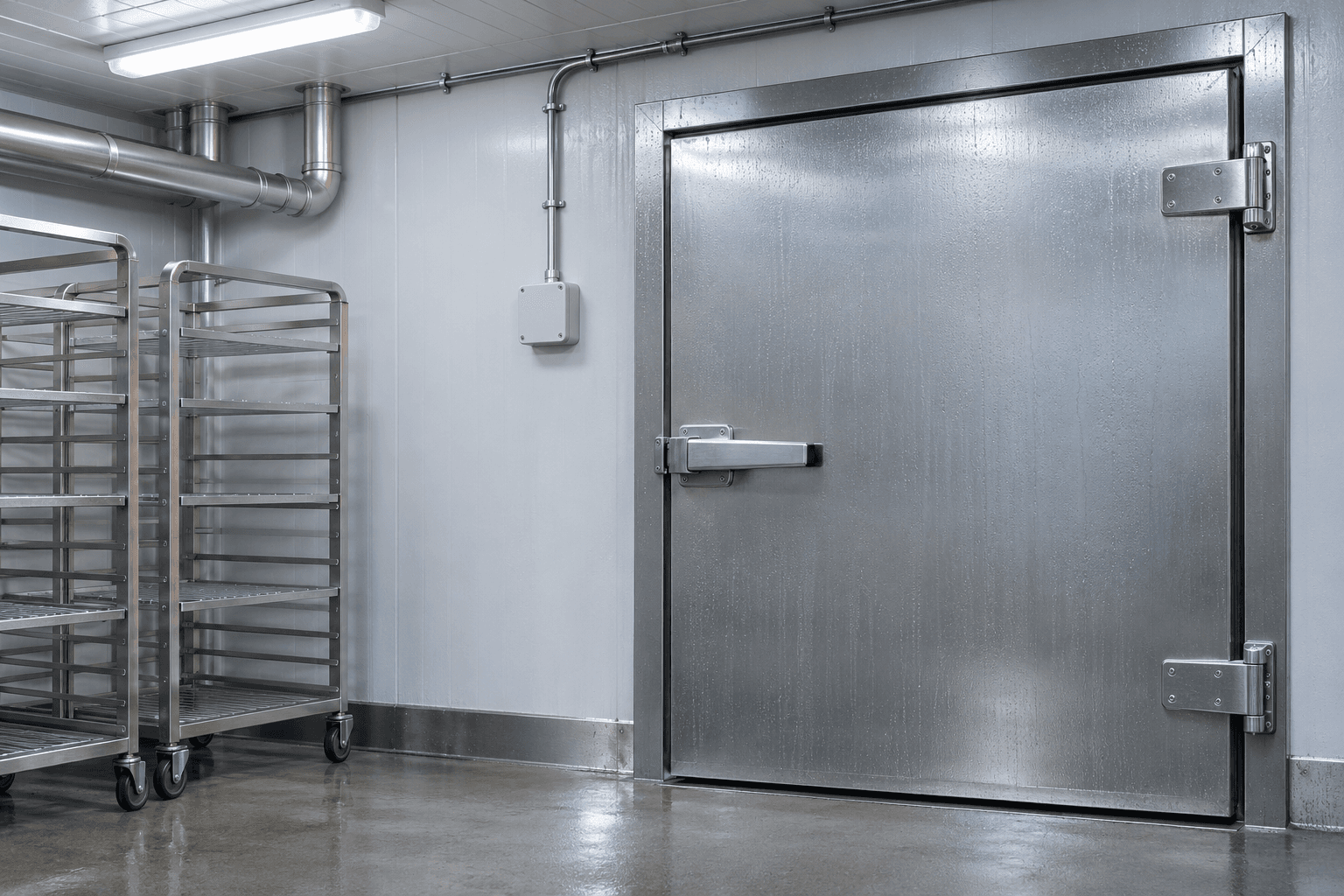
The refrigeration contractor's remote connection is part of the production system. It can help maintain temperatures, manage defrost cycles and keep an operator informed without a technician standing beside the equipment. It can also carry authority over the conditions that keep inventory usable. A November 5 warning from five U.S. agencies makes that relationship explicit: attacks on industrial refrigeration can change the physical process and deprive operators of the information needed to recognize the change. The security boundary has to protect both control and visibility.
CISA, the FBI, Health and Human Services, the Department of Agriculture and the Department of Transportation issued the joint fact sheet. They say they are aware of malicious cyber activity targeting industrial refrigeration and cold-chain monitoring systems globally. Their warning covers equipment used across healthcare, chemicals, food and agriculture, and transportation, including refrigerated transport. This is a published threat warning with defensive recommendations. It does not provide a complete incident census, identify the perpetrators or establish that every reported cooling failure belongs to one campaign.
The agencies describe attackers targeting electronic temperature controllers and commercial refrigeration controllers at grocery and cold-storage facilities. Unpatched or internet-accessible equipment may be exposed through authentication bypass, code injection or weak configurations. Successful interference can force heating or defrost activity. These are several possible routes to a harmful operating state, not evidence that one particular vulnerability explains all the incidents. A response organized exclusively around finding a single patch would therefore be narrower than the problem described in the warning.
The possible consequences extend beyond a refrigerator that briefly runs warm. The fact sheet lists inventory loss, damage to equipment service life, fire hazards and indirect harm if products are consumed after unsafe storage. Those are potential effects, not a declaration that the agencies have documented each outcome. It separately identifies loss of visibility into current temperatures. That second failure matters because an operator needs trustworthy information to decide whether the process is under control. A reachable management screen alone cannot establish that the goods behind it have remained safely stored.
Earlier European evidence gives the warning a concrete history. CERT-FR's alert, first issued October 12 and updated October 16, identifies numerous compromises affecting Danfoss AK-SM and AK-SC controllers and Copeland and Dixell XWEB systems. The French response guidance calls for removing internet exposure and reviewing the complete configuration, specifically including defrost settings. It also warns that resetting an unsupported device while leaving it exposed is insufficient: the conditions enabling another compromise remain. Recovery of a device and removal of its exposure are separate tasks.
Industry reporting shows why the healthcare scope is not merely hypothetical. Cooling Post reported on November 4 that the French Blood Establishment's monitoring and alarms detected altered temperature and defrost thresholds at three sites. According to the EFS account reported by the publication, the response prevented blood products or samples from being compromised. That is an account of successful containment, not evidence of spoiled blood or patient injury. On November 5, Cooling Post also reported European Commission monitoring and coordination with European and national cybersecurity bodies.
The federal recommendations begin with exposure. Controller panels should not be directly accessible from the public internet. Where remote access is necessary, the agencies call for protection through a firewall or edge device kept current with security updates. The qualification is operationally important: they are not saying refrigeration should lose every useful connection. They are saying the route into equipment capable of changing physical conditions needs a maintained security boundary. Moving a vulnerable controller behind an equally neglected gateway would leave an important part of that recommendation unfinished.
Network separation addresses a different boundary. The agencies recommend a dedicated operational-technology virtual local area network, separated from business networks. Our reading is that operators should treat this as a documented separation of functions, with access limited to what the refrigeration service requires. The fact sheet also calls for device and IP-address allowlisting so only authorized sources can make changes. The two measures belong together: identifying an OT network is useful, but the permitted paths into it determine which outside systems retain influence over the equipment.
Credentials remain part of that influence. The warning calls for changing default passwords, enforcing stronger password policies and using phishing-resistant multifactor authentication wherever feasible. The last qualification should survive implementation planning. A buyer should establish which part of the access path supports the stronger authentication rather than assume every installed controller has the same capabilities. For service providers, the practical question is whether the arrangements used for routine maintenance also constrain who can change operating parameters. The agencies do not publish a universal authentication configuration for every product.
Firmware and support status introduce a capital-planning problem. The agencies recommend keeping firmware current and establishing a lifecycle process to identify, retire and replace unsupported equipment. That is more demanding than an emergency update campaign. A controller can still perform its refrigeration function while no longer receiving security fixes. In that situation, continued operation and continued secure support have different timelines. Operators need to know which installed units can be brought to a supported state and which require replacement planning, with the equipment manufacturer and qualified service staff involved.
The UK National Cyber Security Centre's connectivity guidance provides useful background on that tradeoff. It says obsolete products should not be trusted to implement security controls and treats segmentation as a possible temporary measure while replacement is planned. It also calls for documenting the business need for a connection, its benefits, acceptable risk, external dependencies and a senior risk owner. Applied here, the decision is larger than whether remote maintenance saves a visit. It includes whether the organization can sustain the security boundary and operate when that connection is unavailable.
The strongest argument against simply disconnecting everything is that connectivity already performs useful work. The federal fact sheet names continuous temperature logging, remote monitoring, defrost management and energy optimization among legitimate functions. Removing a connection without understanding which of those functions depends on it could create an operational problem of its own. Our recommendation is to distinguish unnecessary exposure from necessary, controlled service access, and to coordinate changes with the people responsible for the refrigeration process. The desired result is a safer operating system, with a known way to supervise it.
Isolation planning makes that distinction practical. NCSC recommends testing isolation as part of business continuity, understanding supplier obligations and planning for a shift from remote support to physical attendance where necessary. It distinguishes whole-site isolation from selective isolation of an affected service. For operators with several locations, it also calls for planning beyond a single site and identifying essential data flows that need to continue safely. This is background guidance, not proof that a particular attacked facility had those arrangements. It explains why an isolation plan needs operational ownership before an incident.
A refrigeration business can turn that principle into a straightforward planning exercise. If a maintenance connection must be suspended, who can authorize the suspension, who checks local operation and who responds to the next alarm? These are proposed management questions, not a universal equipment procedure. Their value is in exposing dependencies before an urgent decision. A contract that assumes every service action happens remotely may not describe the staffing and response needed during isolation. The operator and contractor should resolve that gap together rather than discover it while recovering equipment.
Visibility needs its own recovery path. The agencies recommend enabling and reviewing logs, and collecting network communications when OT assets have missing or nonstandard logs. That is a pragmatic acknowledgment that the installed fleet may not produce uniform evidence. In our assessment, a useful review should connect unexpected access or configuration activity with the process information operators already depend on. A pile of retained traffic is not itself an operating decision. Someone needs responsibility for evaluating anomalies and escalating them to people who can assess the physical equipment.
The most process-specific recommendation concerns downstream limits. The agencies urge operators to define reasonable setpoint ranges for devices below the supervisory controller and establish alerts for deviations. This aims to constrain the consequences of an inappropriate command, alongside controlling who can issue it. The fact sheet supplies no universal safe temperature or defrost schedule, and neither should a general security article. Those limits depend on the equipment and process. They need to be established and maintained by qualified operators, rather than copied from a generic cybersecurity checklist.
Backups serve a separate purpose. The warning calls for current copies kept offsite and offline, with restoration tested. Our practical interpretation is to distinguish restoring a configuration from verifying the resulting operation. A recovered controller still needs an appropriate configuration, a controlled access path and usable monitoring. The published guidance does not certify that loading any saved settings makes a site safe to resume normal service. That distinction protects against treating a successful technical recovery step as the completion of the wider operational response.
For founders building maintenance platforms, sensors or industrial services, the commercial implication is concrete. Remote access is part of what customers buy, so its restrictions, support requirements and failure behavior should be part of what they can evaluate. A product that helps a contractor supervise several sites also needs an understandable way to withdraw access and maintain essential visibility when trust in a connection is lost. This is a design implication of the agencies' recommendations, not a claim about measured market demand or the effectiveness of a particular vendor's product.
The new warning establishes enough to act on without inventing attribution or a global damage total. Controllers are being targeted; both operating settings and temperature visibility are at risk; the agencies identify specific boundaries, maintenance practices and process safeguards to review. The next useful evidence from an operator is an accountable access map, supported equipment, tested recovery and a workable isolation arrangement. For the contractor, it is the ability to keep providing a controlled service when the normal remote route must change. Refrigeration security ultimately has to survive contact with the operating floor.
LaunchPad positionProtect control and visibility together. Secure service access, supported equipment and tested isolation belong in the same operating plan.
This report draws on the linked primary sources and reputable reporting. Company statements are treated as claims until independently demonstrated.