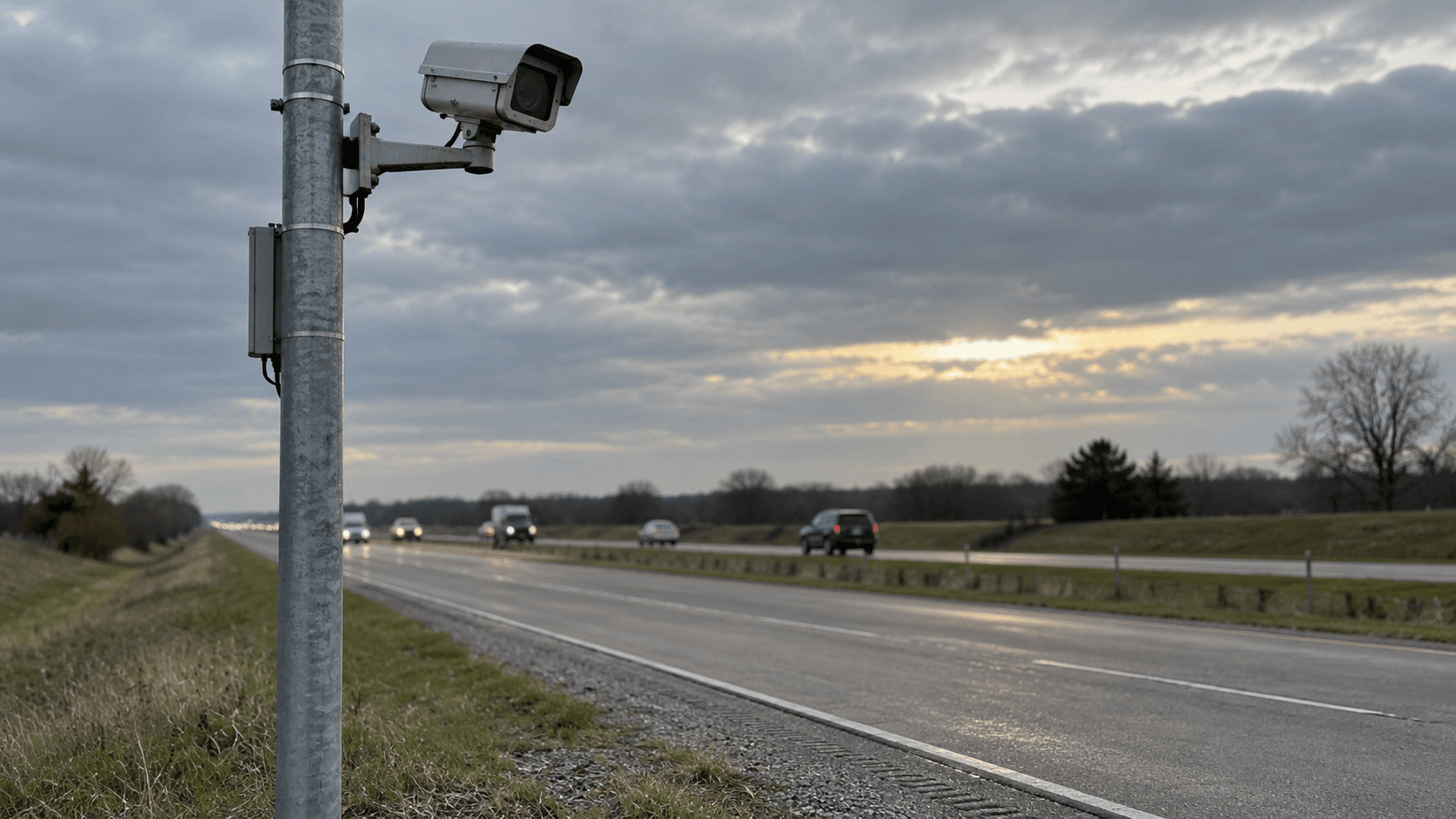
A license plate was enough to open the file. According to a federal court's account, Tulsa County Deputy Sheriff Freddie Alaniz saw a California plate, queried a vehicle-location database and began reconstructing a stranger's trip. The useful distinction in the resulting decision is not between a camera that works and one that fails. It is between observing a passing vehicle and retrieving a history assembled before there was a reason to investigate its driver. A system can perform its advertised function accurately and still produce evidence a court will not allow the government to use.
On October 1, Judge Sara E. Hill of the Northern District of Oklahoma granted Melisa Susan Kyle's motion to suppress in United States v. Kyle. The 38-page order finds both an unlawful extension of a traffic stop and an unconstitutional warrantless search of historical license-plate data. Those are separate grounds, with different implications. This is a decision about evidence in one criminal case, not an acquittal and not an order shutting down every plate-reader network. Its significance comes from the reasoning about accumulated movement records, and from the investigation's chronology.
The order describes Alaniz having access to Flock and VehicleManager, two automated license plate reader systems with different capabilities. Cameras on his patrol vehicle contributed plate information to larger networks. Records paired a plate with a time, date and location. He could access at least 30 days of information in many states, but not California. The court also said the record did not establish the ultimate retention period or who kept the information. Those gaps should remain gaps. A month available to this officer does not establish a universal deletion policy, and missing California records do not establish a complete account of a California visit.
After the initial query, Alaniz saw a short-turnaround journey toward the California-Arizona border and back toward Missouri. The systems offered fields for recording the reason for a search. He entered reasons referring to a traffic violation and an investigation, although the court found that, at the time, he knew only that the vehicle had a California plate. That is a concrete warning about accountability design. A required explanation field can record a user's assertion without establishing that the asserted basis existed. The distinction is visible only when the entry is compared with the sequence of events.
The judge did not reject everything the officer did. After following the vehicle, Alaniz observed driving that the court found gave him an objectively reasonable basis to stop it for following another vehicle too closely. That finding matters because it prevents the case from collapsing into a simple story about a wholly invented traffic stop. The court could accept a basis for the roadside stop while rejecting the earlier database search and the later detention. Each action had its own timing and justification. Permission for one did not resolve the others.
The roadside conversation then became an interpretation problem. Kyle described a long drive, a short visit, relatives near a state border and luggage accumulated during travel. The government argued that her answers and circumstances supported suspicion of drug trafficking. Hill examined the conversation and video rather than accepting the officer's description at face value. Kyle's effort to recall a departure day sounded to the judge like thinking aloud, not changing her story. Her references to places in California and Arizona were geographically compatible. The location results themselves appeared to support that part of her explanation.
Luggage received some weight, but little. Smoking and use of a rental car did not add weight under the circumstances the court reviewed. Alaniz described unusually intense nervousness; Hill said the record showed ordinary nervousness without the extreme physical manifestations asserted. The order considered the circumstances together, not merely as disconnected items to dismiss individually. Its objection was the missing explanation connecting these ordinary travel details to criminal activity. For anyone building analytical tools, that is an important distinction: collecting more attributes is not the same as demonstrating what those attributes mean.
Timing also defeated the government's reliance on Kyle's disclosure that marijuana was in the vehicle. Alaniz had already returned her license, issued a warning, requested permission to search, received a refusal and announced a further detention before that disclosure. Hill concluded that he lacked reasonable suspicion to extend the stop when he did. Information obtained afterward could not supply the justification missing at that earlier point. The order suppressed evidence on this ground independently of its plate-reader analysis. A summary that discusses only Flock would miss a substantial part of why the government lost the motion.
The database question reaches a different layer. Hill acknowledged that nearly every court she found addressing automated plate-reader searches had reached the opposite conclusion, including other federal courts in Oklahoma. She also stated that neither the Tenth Circuit nor the Supreme Court had decided this particular question. Her opinion therefore argues through an unsettled issue; it does not announce that an existing nationwide appellate rule already prohibits the practice. That distinction is essential for readers assessing the commercial or operational implications. A serious adverse ruling can matter without being the final nationwide answer.
The government's central argument was that the information concerned movements visible on public roads. Hill addressed the Supreme Court's 1983 Knotts decision, involving a tracking beeper in a chemical container, and objected to treating its public-movement language as sufficient for a much larger network. Her analysis also relied on Carpenter and the more recent Chatrie decision concerning historical phone-location information. The account here is of Hill's reasoning, not a claim that those phone cases had already decided every question about vehicle cameras. The technical differences remain part of the dispute.
More than 50 sightings across multiple states over a month were available in Kyle's case, according to the order. Hill expressly recognized that this was less precise than phone-location tracking. She nevertheless saw a privacy interest in the assembled history that was not answered by saying each individual sighting occurred in public. The network collected first and allowed officers to choose a vehicle later. That sequence makes retrospective inquiry possible without having selected the person for investigation when the observations were made. It is the source of the capability under examination, not an incidental detail about camera placement.
This does not turn a plate record into continuous GPS tracking. Nor does the opinion establish that 50 sightings is a universal legal threshold, that 49 would be safe, or that a month is the only relevant duration. The facts describe the search before this court. For a buyer evaluating the technology, the appropriate technical questions are more specific than whether the product captures public images: how much history a query can return, which networks contribute, what gaps are visible and how the result is connected to an investigation. Those are evaluation questions, not a substitute for legal review.
Hill concluded that this search invaded Kyle's reasonable expectation of privacy in her overall movements and lacked both probable cause and a warrant. The order connected it to the subsequent evidence because Alaniz began following the vehicle while performing the search. With no adequate exclusionary-rule exception identified by the government, the judge ordered suppression of evidence obtained after the query began. The practical consequence was therefore not just criticism of a surveillance product. It was the loss of evidence obtained through this sequence of investigative acts.
Flock disputes the ruling's broader significance. In a statement published by 404 Media, the company said it was not a party, described the order as contrary to the weight of other decisions, and expected an appeal and reversal. It emphasized the case-specific facts and absence of controlling precedent. Those are the company's positions and expectations, not confirmation that an appeal has been filed or that the order has been reversed. The independent report supplies an important counterweight to reading the decision as an uncontested settlement of the issue.
The company's earlier public position illustrates why the disagreement is substantive. In October 2025, Flock celebrated a Virginia appellate reversal and argued that its cameras captured public-road images rather than the whole of a person's movements. That historical statement also promoted audit trails and local data policies. It should not be treated as a current inventory of all relevant rulings. But it identifies the contested proposition: whether the limitations of individual vehicle sightings prevent a network's combined history from receiving the privacy protection Hill applied. The new order answers that question differently on this record.
For product teams, a useful response starts with distinguishing collection, retrieval and downstream use. The Kyle order scrutinizes a particular retrieval and the evidence flowing from it. It does not certify an alternative architecture as lawful. Still, it gives procurement teams reason to ask for a demonstration of how search scope is controlled and how its basis can be checked. A broad account permission is not the same thing as a documented basis for each inquiry. A generic purpose label is especially weak evidence if it cannot be reconciled with what the officer knew before submitting the query.
An audit should preserve that chronology rather than merely count searches. Reviewers need to be able to compare the query, its stated reason, the returned records and the investigative actions that followed. The underlying observations should remain distinguishable from the conclusions drawn from them. In this case, an absence of California access limited what could be established from the route history, while the border-area records supported part of Kyle's account. A presentation that makes the map look complete or strips away conversational context could obscure either limitation. These are proposed review standards, not claims that a particular interface has been proven defective.
Police have legitimate reasons to seek evidence efficiently, and Hill acknowledged the benefits of plate-reader technology. The counterargument deserves more than a dismissal: public-road observations and comparatively sparse vehicle sightings are not identical to intimate phone-location records. But that difference cannot settle the engineering requirements on its own. The order shows a court examining what a network enabled in practice, how an officer used it and when supporting facts actually became available. For agencies and vendors, the next defensible demonstration is an investigation whose authority and evidence can survive that reconstruction. More records alone will not provide it.
LaunchPad positionEvaluate the scope and chronology of each historical-location query, while keeping this case-specific ruling separate from a nationwide legal conclusion.
This report draws on the linked primary sources and reputable reporting. Company statements are treated as claims until independently demonstrated.