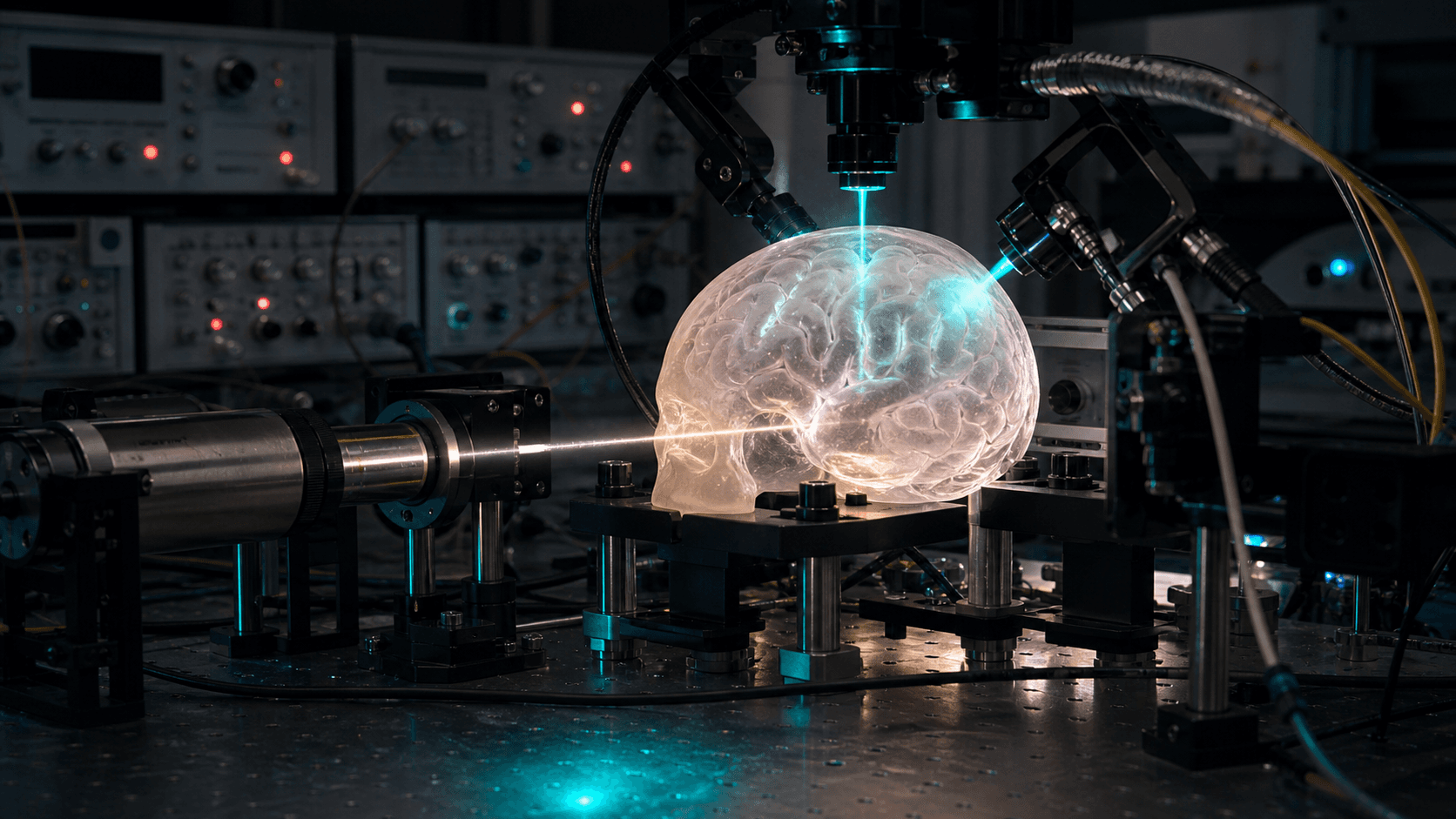
Brain interfaces still make researchers choose between signal quality and surgery. Implanted electrodes can approach individual neurons in real time, but implantation adds medical risk and long-term biological complications. Noninvasive imaging avoids the incision and usually measures slower proxies such as blood flow.
DARPA's Firefox program is aimed directly at that tradeoff. The agency wants to use targeted light to detect the microscopic physical movement of neural membranes as neurons fire. If the effect can be captured reliably through tissue, the signal would be closer to the underlying electrical event without putting an electrode into the brain.
The gap between a clever measurement and a useful interface is enormous. DARPA says current experimental models are limited to a single sensor channel, while the resulting data can overwhelm conventional digital computing. Over a proposed 36 months, Firefox will pursue dynamic optical scanners capable of reading multiple regions and analog processors that handle the data stream as it arrives.
Analog processing is not a retro aesthetic choice. It is an attempt to compute on the continuous signal before converting every detail into a digital fire hose. That could reduce latency and power if the sensing physics holds. It also ties the scanner and processor together, which means errors in calibration, tissue variability, noise rejection, and hardware stability cannot be hand-waved away as somebody else's layer.
Firefox was published as an opportunity on August 25, with a proposer day scheduled for September 21. No high-fidelity human interface has been demonstrated by the program. The next proof is smaller and more honest: show that multiple optical channels can recover useful neural activity through realistic tissue, in real time, without the signal collapsing under noise or the processor collapsing under data.
LaunchPad positionThe program is a solicitation, not a demonstrated brain interface. Its real target is the system bottleneck between fragile one-channel optical measurements and scalable real-time sensing.
This report draws on the linked primary sources and reputable reporting. Company statements are treated as claims until independently demonstrated.